
Top 100 IA · Estados Unidos
Chelsea Finn
Stanford 
- Puntuación
- 71270 hoy
- Puesto
- 80/198 ↓3
- en 90 días
- +350+4,8 %
Chelsea Finn es profesora asistente de Ciencias de la Computación e Ingeniería Eléctrica en la Universidad de Stanford y cofundadora de Physical Intelligence. Se especializa en inteligencia artificial, robótica y aprendizaje automático, compartiendo frecuentemente hallazgos de investigación, benchmarks y aplicaciones prácticas de sistemas robóticos. Su contenido incluye análisis detallados del rendimiento de modelos de IA, tareas de robótica y recursos educativos como videos de conferencias y charlas de talleres.
Datos a 25 oct 2026.
Las cifras brutas · últimos 90 días
- Visualizaciones medianas
- 42,8 mil
- por publicación
- Interacciones medianas
- 435
- por publicación
- Publicaciones
- 10
- en 90 días
- Seguidores
- 129,3 mil
- todas las redes puntuadas
Qué compone la puntuación
Percentiles 0 – 100 frente a todos los creadores seguidos.
- Alcance · 30 %86
Visualizaciones medias por publicación en 90 días
- Interacción · 30 %70
Reacciones medias por publicación
- Audiencia · 30 %75
Seguidores acumulados, en relación con la población
- Regularidad · 10 %63
Ritmo de publicación (25 posts / 90 d = 100)
Redes
129,3 mil seguidores acumulados
| Red | Seguidores | Puntuación |
|---|---|---|
| X@chelseabfinn | 105,9 mil | 8277t2 |
| LinkedIn@cbfinn | 23,3 mil | 2599t9 |
Últimos 30 días
Las mejores publicaciones de Finn
 X · hace 13 d#1CFChelsea Finn
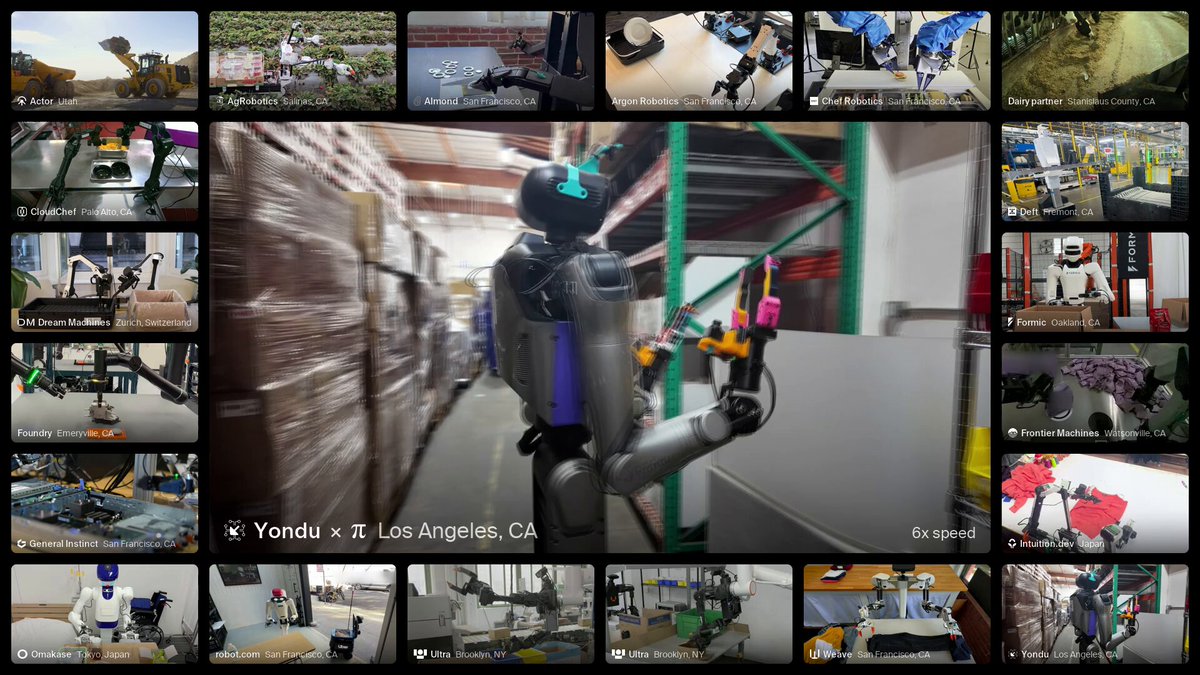
The Pi API is officially in beta! 🤖 Many people have already been using it to fine-tune π models for their robots -- below are a few We’re hoping to expand testing significantly. Let us know if you are interested! Bl…
29,1 mil visualizaciones582 interacciones
- X · hace 17 d#2
As robots become more reliable, DAgger becomes far less efficient. eg 90% success means the person spends >90% of the time passively watching the robot Key idea: failures come from similar initial states & we c…
CFChelsea Finn38,5 mil visualizaciones398 interacciones
- X · hace 22 d#3
Scientific discovery is one of the most exciting applications of LLMs, but we lack data & evals on the scientific process. ScholarCatalyst captures which prior papers can advance new research on a problem, rather …
CFChelsea Finn28,6 mil visualizaciones344 interacciones
 X · hace 5 d#4CFChelsea Finn
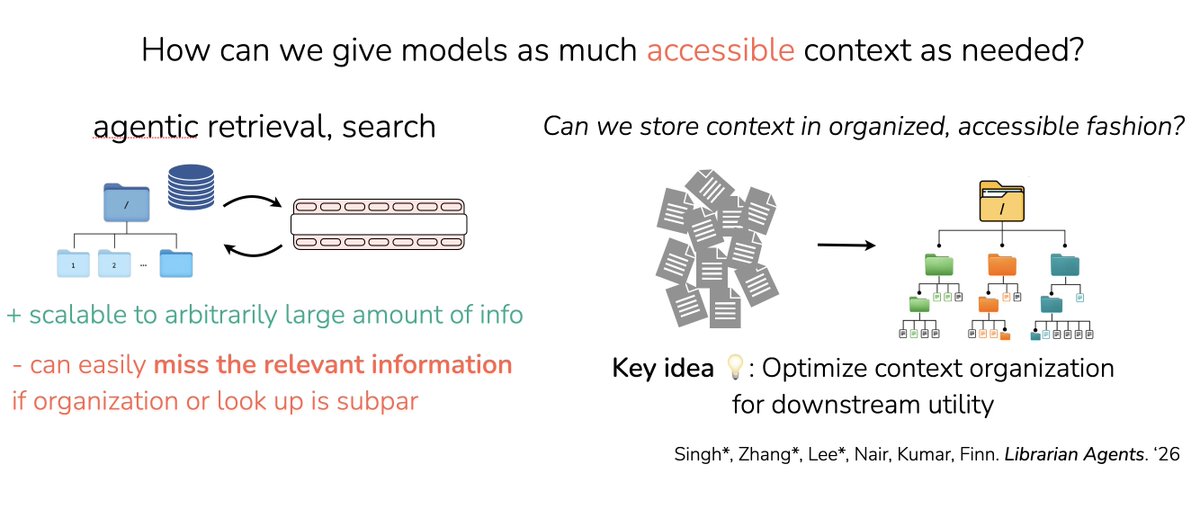
How do we scale up the context of LLMs? Agentic search scales to arbitrarily large amounts of info, but can easily miss relevant info. Idea💡: Optimize organization of info for downstream utility. Leads to 30+% gains …
24 mil visualizaciones340 interacciones
- X · anteayer#5
Generative value classifiers are a new parametrization of Q-functions that don't require action conditioning. We think these may combine gracefully with large, pre-trained policies and learn/generalize better from a r…
CFChelsea Finn18,2 mil visualizaciones312 interacciones
Cara a cara