
Top 100 IA · États-Unis
Chelsea Finn
Stanford 
- Score
- 7 1270 auj.
- Rang
- 80/198 ↓3
- sur 90 jours
- +350+4,8 %
Chelsea Finn est professeure assistante en informatique et génie électrique à l'université de Stanford et cofondatrice de Physical Intelligence. Elle est spécialisée en IA, robotique et apprentissage automatique, partageant régulièrement des résultats de recherche, des benchmarks et des applications pratiques de systèmes robotiques. Son contenu inclut des analyses détaillées des performances de modèles d'IA, des tâches en robotique, ainsi que des ressources éducatives comme des vidéos de cours et des conférences d'ateliers.
Données au 25 oct. 2026.
Les chiffres bruts · 90 derniers jours
- Vues médianes
- 42,8 k
- par publication
- Interactions médianes
- 435
- par publication
- Publications
- 10
- sur 90 jours
- Abonnés
- 129,3 k
- tous réseaux scorés
Ce qui fait le score
Centiles 0 – 100 face à tous les créateurs suivis.
- Portée · 30 %86
Vues moyennes par publication sur 90 jours
- Engagement · 30 %70
Réactions moyennes par publication
- Audience · 30 %75
Abonnés cumulés, rapportés à la population
- Régularité · 10 %63
Rythme de publication (25 posts / 90 j = 100)
Réseaux
129,3 k abonnés cumulés
| Réseau | Abonnés | Score |
|---|---|---|
| X@chelseabfinn | 105,9 k | 8 277t2 |
| LinkedIn@cbfinn | 23,3 k | 2 599t9 |
30 derniers jours
Les meilleurs posts de Finn
 X · il y a 13 j#1CFChelsea Finn
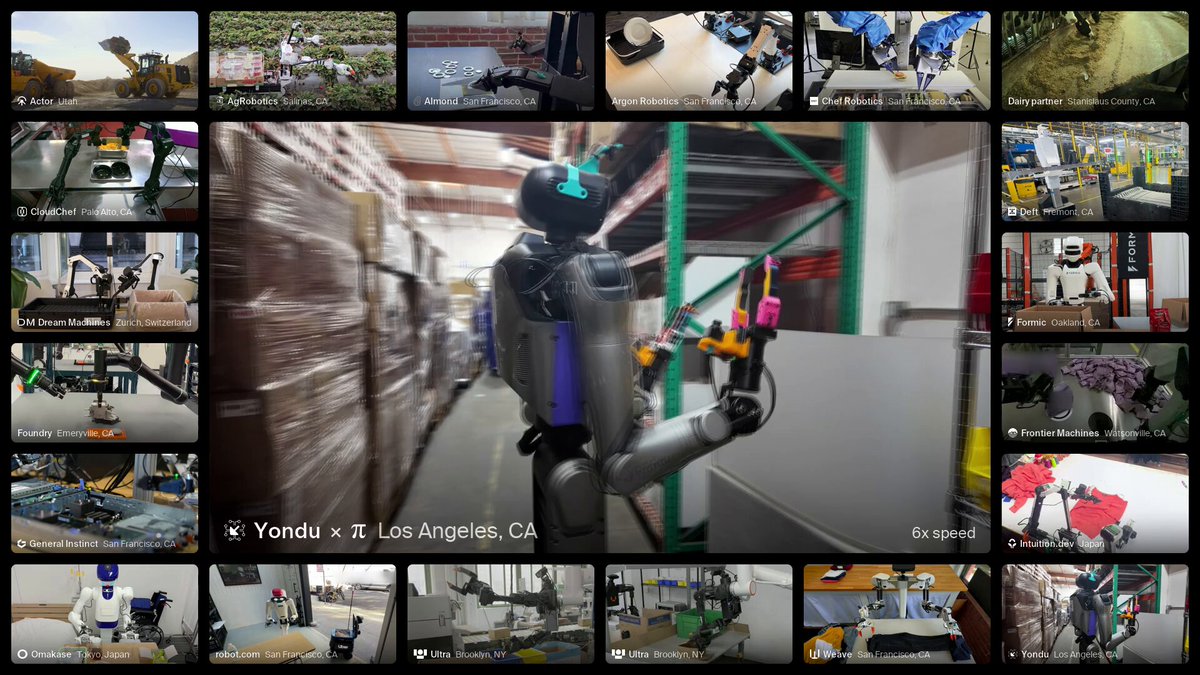
The Pi API is officially in beta! 🤖 Many people have already been using it to fine-tune π models for their robots -- below are a few We’re hoping to expand testing significantly. Let us know if you are interested! Bl…
29,1 k vues582 interactions
- X · il y a 17 j#2
As robots become more reliable, DAgger becomes far less efficient. eg 90% success means the person spends >90% of the time passively watching the robot Key idea: failures come from similar initial states & we c…
CFChelsea Finn38,5 k vues398 interactions
- X · il y a 23 j#3
Scientific discovery is one of the most exciting applications of LLMs, but we lack data & evals on the scientific process. ScholarCatalyst captures which prior papers can advance new research on a problem, rather …
CFChelsea Finn28,6 k vues344 interactions
 X · il y a 5 j#4CFChelsea Finn
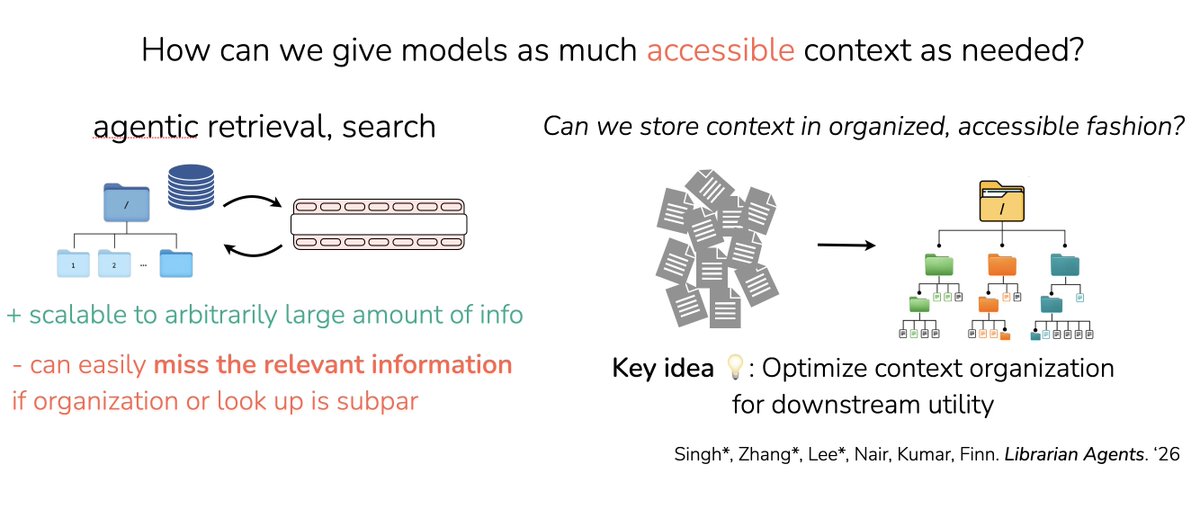
How do we scale up the context of LLMs? Agentic search scales to arbitrarily large amounts of info, but can easily miss relevant info. Idea💡: Optimize organization of info for downstream utility. Leads to 30+% gains …
24 k vues340 interactions
- X · avant-hier#5
Generative value classifiers are a new parametrization of Q-functions that don't require action conditioning. We think these may combine gracefully with large, pre-trained policies and learn/generalize better from a r…
CFChelsea Finn18,2 k vues312 interactions
Face-à-face